
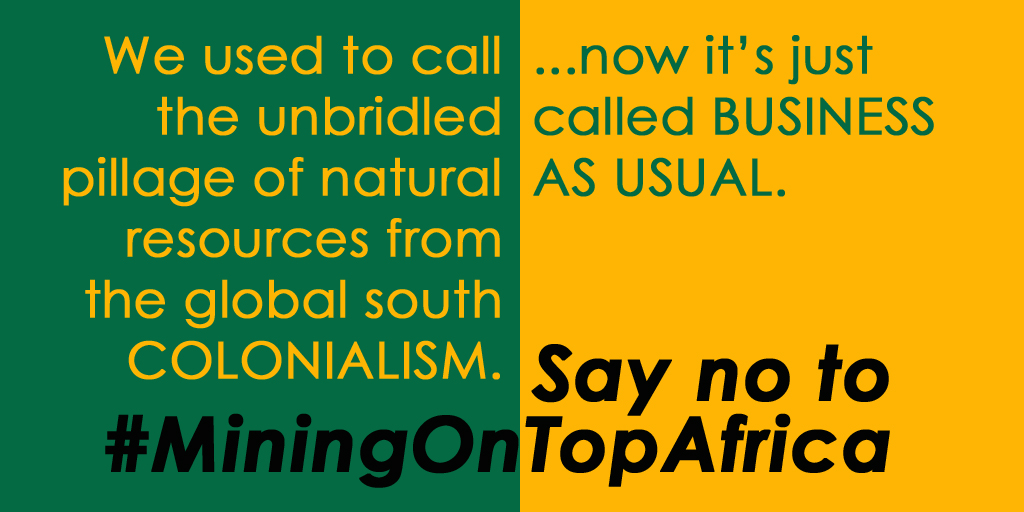
 Today civil society groups from Africa and their allies in the UK submitted a powerful open letter to the organisers and delegates of the Mining on Top Africa: London Summit in central London. The letter challenges the validity and motivations of the Summit, which civil society says lacks representation from African communities and civil society, and ignores the negative impacts of mining in Africa.
25/06/2015
Delegates and Organisers of the Mining on Top Africa: London Summit,
We, members of African and UK civil society and communities, are aggrieved that the Mining on Top Africa: London Summit lacks meaningful representation from African civil society and communities, and ignores the negative impacts of mining in Africa.
Our organisations are rooted in and work alongside numerous communities across the African continent who endure the worst impacts of large-scale mining, without enjoying any of the purported benefits.
Many of these communities are facing displacement, poverty, illness, massive pollution, loss of fertile agricultural and ancestral land, destruction of livelihoods and culture due to the introduction of large-scale mining. Seeing little-to-no benefit from Africa’s mining boom, a growing number are saying Yes to Life, No to Mining, protecting sustainable, regenerative livelihoods and affirming their basic human right to define their own development.
As a gathering supposedly hosted to ‘drive economic and social development in Africa’, it would seem imperative for the Mining on Top Africa: London Summit to create spaces to hear the voices of these African communities and civil society members.
Yet it is precisely these groups- and those working in solidarity with them – that are being excluded from discussions. In their absence the Summit appears to be little more than a modern-day carve-up of Africa, with the imperial powers of old now replaced by massive multinationals engaging in similar forms of colonial exploitation that are destroying Africa.
In particular, we note that the only official civil society speaker at the Summit appears to be talking from a Northern development NGO, and a business-oriented perspective on companies’ social license to operate. This is revealing, as many of our communities are realising that Corporate Social Investment and Responsibility are purely ways to justify the companies’ social licence and bolster their image. We are sure the attendees from extractive industry companies may be happy to hear this, but it is less clear how such presentations will provide meaningful information on the real concerns of local communities and how they see their development unfolding.
To ensure that the concerns of African communities, and the many examples of serious mining abuses committed against them, do not go unheard, at the end of this letter (click here to read) we include cases that partners have asked us to highlight. They reveal the following trends plaguing mining in Africa:
· Ecosystem destruction and the persistent pollution of air, water and land with grave health impacts for human communities and many other species.
· Human rights abuses including killings and physical abuse that often disproportionately affect women.
· Evictions and the forcible relocation of communities.
· The failure of Corporate Social Responsibility and Investment programmes.
· The loss of billions of dollars of mining profits from African economies as a result of illicit financial flows, corruption and corporate malfeasance.
· The threat further investment in fossil fuel extraction, and thus climate change, poses to future generations.
That the Mining on Top Africa Summit excludes the voices of the peoples directly affected by trauma and loss as a result of the extractive industries strips the event of all legitimacy and any association with development. This is all the more unforgivable for the government agencies involved, such as the UK’s DfID, who are meant to be promoting inclusive development.
Sadly, it is fitting that this carve-up should take place in London, with the active encouragement of the British Government.
London is the leading global centre for mining finance, with billions of pounds of investment money flowing through it into destructive mining projects around the world. The UK Government actively encourages such destructive mining through its diplomatic support for London-listed mining companies, its shocking failure to exercise adequate regulatory oversight and its involvement in gatherings such as this one.
Acknowledging our connection through our common humanity, we as members of African and UK civil society demand that the mining industry hears and respects the wishes of communities who reject the destruction mining brings. We demand that the UK ends its promotion of and support for mining destruction.
In solidarity with communities in Africa devastated by destructive mining, and those resisting fresh waves of exploitation, we call for an end to the corporate carve-up of Africa.
Signed,
Sheila Berry for Global Environmental Trust and Save Our iMfolozi Wilderness (S.Africa)
Juliana Thornton for Mupo Foundation and Yes to Life, No to Mining (S. Africa)
Tabaro Dennis Natukunda, Kureeba David and Shillar Osinde for National Association of Professional Environmentalists (Uganda)
Gijs Verbraak and Christopher Rutledge for Action Aid South Africa
Thokozile Madonko for Alternative Information & Development Centre, (AIDC)
Milena Müller-Schöffmann for WIDE -Network for Women´s Rights and Feminist Perspectives in Development
Simon Mitambo for African Biodiversity Network
Cormac Cullinan for EnAct International
Davine Cloete for Agrarian Reform for Food Sovereignty Campaign and South African Food Sovereignty Campaign (South Africa)
Dieudonné Tshimpidimbua for Le Conseil régional des Organisations Non Gouvernementales de Développement du Kasai Oriental (DRC)
Action Paysanne Contre la Faim RDC for Action Paysanne Contre la Faim (DRC)
Raoul Kitungano for L’organisation Justice Pour Tous (DRC)
Maurice Ouma Odhiambo for Jamaa Resource Initiatives, Kenya
Christian Bwenda for PREMICONGO (DRC)
Asanda Benya, Sociology Department, Wits University (South Africa)
Hannah Owusu-Koranteng for Wacam (Ghana)
Sandy Heather for Sustaining the Wild Coast (South Africa)
FDS Mali for FDS Mali
Delphine K Djiraibe for PILC CHAD (Chad)
Francis Smith for GEOSURE (South Africa)
Umo Isua-Ikoh for Peace Point Action (PPA)
Emma Courtine for ICCA Consortium (Worldwide)
OUSSOU LIO Appolinaire for GRABE BENIN (Benin)
Chris Macoloo for World Neighbors, founder member of Alliance for Food Sovereignty in Africa (AFSA)
William F. Laurance, PhD, FAA, FAAAS for ALERT Conservation
Frank Luvanda for Mazingira Network – Tanzania (MANET)
Aldo Salomao for Centro Terra Viva
Tracy Sonny for Botswana Climate Change Network
Pastor Innocent Adjenughure for Niger Delta Study Group on Extractive Sector (NIDESGES) (Nigeria)
Ronald Naluwairo for Advocates Coalition for Development and Environment
Ted Brooks Jr for The Committee for Peace and Development Advocacy (COPDA) (Liberia)
Tanzania Centre for Research and Information on Pastoralism (TCRIP) for Tanzania Centre for Research and Information on Pastoralism
Solli Ramatou for Groupe de Réflexion et d’Action sur les Industries Extractives au Niger (GREN Niger)
Ferrial Adam for 350.org Africa
Dr Tracy Humby, Research Associate, SWOP and Associate Professor for School of Law, University of the Witwatersrand (South Africa)
Comrade Nelson Nnanna Nwafor for Foundation For Environmental Rights,Advocacy & Development (FENRAD) (Nigeria)
Mukete Tahle for Global Network for Good Governance (GNGG) (Cameroon)
Daniel Banuoku and Bern Guri for Centre for Indigenous Knowledge and Organisational Development (CIKOD) (Ghana)
Geoffrey and Sharon Joyce Smailles (Unaffiliated) South Africa
Paolyel MP Onencan for Buliisa Initiative for Rural Development Organisation (BIRUDO) (Uganda)
Fe Haslam for Global Justice Forum (UK/Africa)
Joleen Wilson and Astika Bugheloo for Afzelia Environmental Consultants (PTY)Ltd (South Africa)
Mag.Manfred Golda for Protestant Association for Word Mission, EAWM (Austria)
Richard Ellimah, The Centre for Social Impact Studies (CeSIS)
Bonita Meyersfeld, Centre for Applied Legal Studies, Wits University (South Africa)
Tony Dykes for ACTSA (South Africa)
John Cunnington for Development Alternatives
Fabio Laurenzi and Marirosa Ianelli for COSPE Onlus and Stop Water Grabbing
Tony McPhail (unaffiliated)
Kofi Mawuli Klu for PANAFRIINDABA (UK)
Esther Stanford-Xosei for Pan-Afrikan Reparations Coalition in Europe (PARCOE) (UK)
Hannibal Rhoades for The Gaia Foundation (UK) and Yes to Life, No to Mining EU
Richard Solly for London Mining Network (UK)
Tom Lebert for War on Want (UK)
David Powe for Divest London (UK)
Andy Whitmore for Stop Mad Mining (EU)
Christine Haigh for Global Justice Now (UK)
Jamie Kneen for Mining Watch Canada
Tero Mustonen for Snowchange Cooperative (EU)
Anne Harris for The Coal Action Network (UK)
Helena Paul for Econexus (UK)